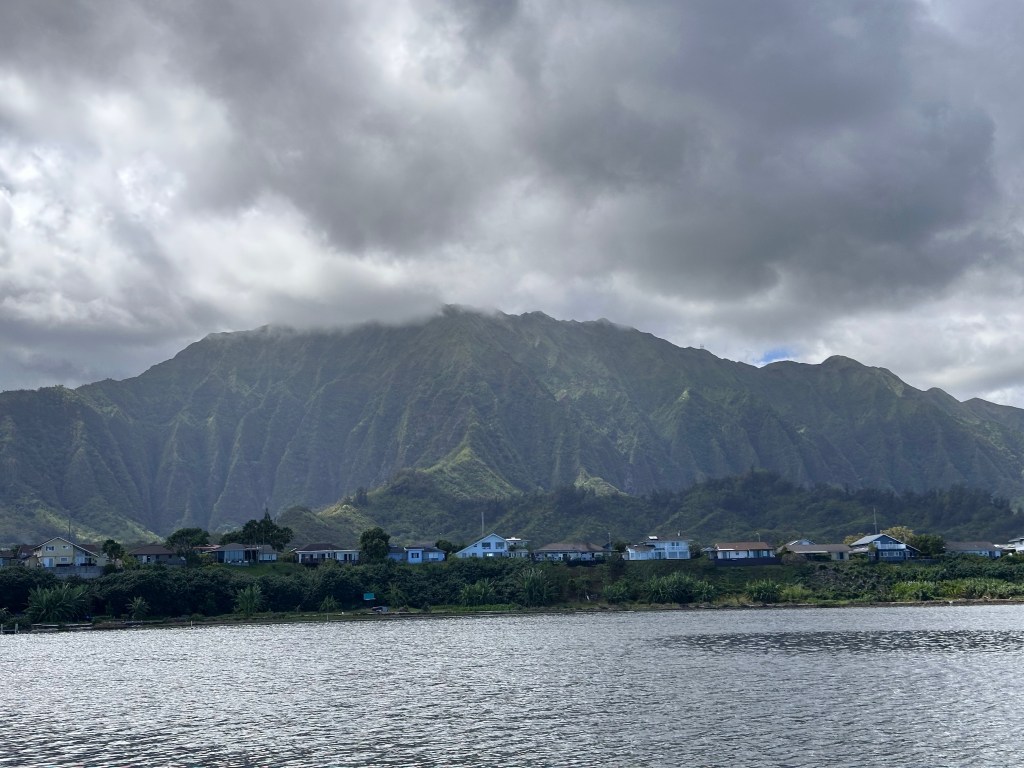
There is a paradox at the heart of Hawai’i economy. On the surface, the islands look prosperous: luxury shopping centers, million-dollar condos, record tourism numbers, a steady influx of federal money, and some of the highest average incomes in the United States. But beneath this visible wealth lies a structural fragility that most people don’t see. Economists who look past the surface notice a contradiction: Hawai’i behaves less like a developed U.S. state and more like a small island economy with narrow production, heavy import dependence, and low self-sufficiency.
The mistake many observers make is confusing prosperity with development. Prosperity is what you can buy. Development is what you can produce. By that standard, Hawai’i is rich in consumption but weak in production. It has money but almost nothing is made here. Less than fifteen percent of the food consumed in Hawai’i is grown locally. Manufacturing is virtually nonexistent. Energy, construction materials, basic consumer goods, and even soil amendments must be shipped from thousands of miles away. A state that imports nearly everything it uses is not a diversified economy; it is a delicate one.
This is why inflation in Hawai’i feels relentless and mysterious. When prices rise, the popular explanation is to blame corporations, real-estate investors, or tourism. But what actually drives Hawai’i’s cost of living is not greed – it is economics. Hawai’i experiences imported inflation: when fuel costs rise in Asia, grocery prices in Honolulu go up; when global shipping rates surge, construction becomes unaffordable; when supply chains collapse, shelves in Costco are suddenly empty. Hawai’i does not set prices – Hawai’i absorbs them.
So why not build more local production? Why not establish factories, food processing plants, or large farms to control costs and reduce dependence on imports? Here is where people misunderstand Hawai’i most deeply: the economic limits are not just technical, they are cultural. Traditional economic development assumes land is something to maximize and exploit. Indigenous Hawaiian knowledge assumes land is something to protect and care for. One mindset demands expansion; the other demands restraint. For many in Hawai’i, ʻāina is not a resource. It is a relative.
This difference matters economically. In the continental United States, development means increasing capacity: more acres farmed, more factories built, more highways, more extraction. In Hawai’i, development is constrained intentionally. There are protections on watersheds, limits on growth, cultural objections to overbuilding, complex land ownership structures, and deep relationships to place. The island is finite, and people know it. Th result is a tension between two visions of the future: one based on efficiency; one based on stewardship.
Meanwhile, the public conversation about sustainability often makes the situation worse. People love the language of “circular economy”, “local resilience”, and “food security”. But circular systems are not abstract ideas – they are labor systems, someone must compost. Someone must dig. Someone must process food waste, run trucks, build facilities, manage logistics, and show up every day to do repetitive, physical work. Hawai’i has no shortage of good intentions. It has a shortage of people willing to participate in real production.
That is why the most uncomfortable economic fact is also the simplest: Hawai’i doesn’t lack money – it lacks productivity. Hawai’i doesn’t lack values – it lacks systems that turn values into output. It is easy to call for self-sufficiency; it is harder to frow, harvest, process, store, and distribute food at scale. Sustainability is not a meeting. Sustainability is labor.
The lesson is not that Hawai’i is broken. It is that Hawai’i must abandon the illusion that it can be “developed” in the same way mainland states are developed. It will never compete with Ohio in manufacturing or Texas in energy or California in industrial agriculture. But neither should it try. Hawai’i’s economic future depends on redefining development on its own terms: slower, smaller, place-based, and culturally aligned. That means supporting regenerative agriculture, community-scale processing, aquaculture, small manufacturing, and Indigenous land stewardship that respects carrying capacity while still creating real output.
Prosperity built on imports in fragile. Prosperity built on production – even small, tight, localized production – is resilient. Hawai’i doesn’t need to industrialize. It needs to produce enough to reduce vulnerability and maintain dignity. The challenge is not to think bigger. The challenge is to act consistently on a human, practical scale.
Most people misunderstand Hawai’i economy because they want simple explanations: greedy corporations, too many tourists, not enough government programs. But the truth is more complex and more interesting. Hawai’i’s economy is a living negotiation between culture and productivity, between values and necessity, between the desire to protect ʻāina and the need to live from it. If Hawai’i can build a model that honors stewardship while embracing real production, it will not become a “developed” economy by mainland standards – it will become something far more valuable: a resilient one.




 Heidi Ahihi
Leave a comment