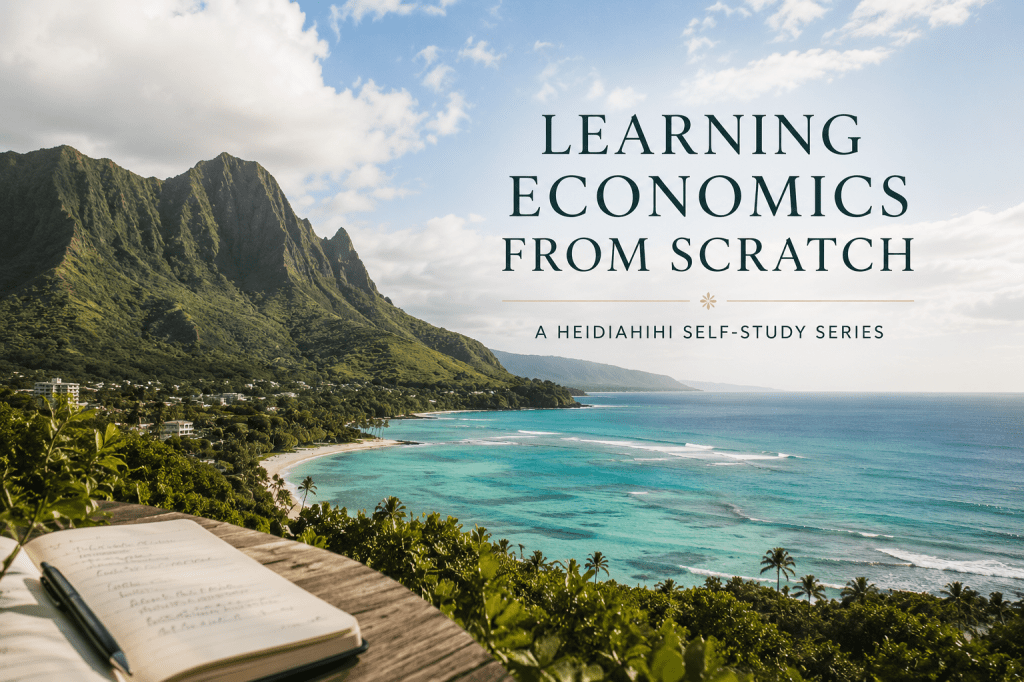
You do not need to become an economist to start thinking like one.
When people hear the word Economics, they often think about money, inflation, interest rates, stocks, GDP, recessions. And then come the graphs. Lots and lots of graphs.
But economics begins somewhere much simpler. It begins with a problem you already face every day: You cannot have everything. So how do you choose?
Scarcity forces individuals and societies to make choices among competing uses of limited resources. That simple idea sits at the foundation of economic reasoning.
Once I started seeing economics this way, it became difficult to keep economics inside a classroom.
It was suddenly everywhere.
Should I work another hour or go home?
Should a student spend several years earning a degree?
Why does someone drive twenty minutes farther to save five dollars?
Why do governments subsidize some activities and tax others?
Why can a decision that makes perfect sense for one person create a bad result when everyone makes the same decision?
Why can something be profitable but still harmful to society?
These questions may look unrelated.
Economics gives us a language and a set of tools fro thinking about all of them.
That is where I want this series to begin.
Not with memorizing definitions.
With learning how to think!
Economics Is Not Just About Money
Economics studies how poeple make choices when resources are limited. And “resources” means much more than dollars.
Time a limited.
Attention is limited.
Land is limited.
Labor is limited.
Natural resources are limited.
Government budgets are limited.
Even the number of hours you can spend learning something is limited.
That means choosing one thing usually means giving up something else.
This is why one of the first ideas we will study is opportunity cost: the value of the best alternative we give up when we make a choice.
A decision can cost almost nothing in money and still be expensive economically.
A free concert ticket still uses your evening.
A scholarship may remove tuition but not the time you could have spent working.
A public park may have no entrance fee, but land, labor, maintenance, and public funds still have alternative uses.
Economics teaches us to look beyond visible prices and ask:
What are we giving up?
The First Skill Is Not Calculation. It is Asking Better Questions.
I used to think studying meant finding answers.
The more I learn, the more I think serious learning begins one step earlier:
Can I formulate the right question?
Imagine that coffee becomes more expensive this year, but people also buy more coffee.
Someone might immediately conclude:
Higher prices made people buy more coffee.
But an economist should become suspicious.
What else changed?
Did income increase?
Did the population grow?
Did another drink become more expensive?
Did consumer preferences change?
Did supply change?
Are price and quantity both responding to another factor?
We have not calculated anything yet.
But we are already doing economics.
We are separating what we observe from what we think explains it.
That habit becomes increasingly important as economics becomes more advanced.
Why Economists Use Models
The real world is messy.
Income changes.
Technology changes.
Preferences change.
Government policy changes.
Expectations change.
Millions of people make decisions simultaneously.
If we tried to include every possible detail in every analysis, we might never understand anything.
So economists use models.
A model is a simplified representation of reality.
The purpose of a model is not to reproduce the world perfectly.
The better question is:
Does this simplification help us understand the problem we are trying to study?
One of the textbooks guiding this project uses an applications-first approach: economic tools are introduced when a real problem makes them useful, and then the same ideas are applied repeatedly across different situations.
I like that way of learning.
Question first.
Then theory.
Then the model.
Then evidence.
Then another question.
Three Lenses for Learning Economics
This series will cover standard economic theory.
But I do not want Heidiahihi to become simply another Economics 101 summary site.
Whenever it makes sense, we will examine economic questions through three connected but distinct lenses.
1. Conventional Economics
This lens asks questions such as:
How are scarce resources allocated?
How do prices coordinate choices?
How do incentives affect behavior?
When do markets produce efficient outcomes?
Why do markets sometimes fail?
This gives us the foundation: scarcity, opportunity cost, supply and demand, elasticity, consumer choice, firms, market structure, game theory, macroeconomics, and eventually econometrics.
2. Sustainable Economics
Sustainability introduces another set of questions:
Can this economic activity continue?
Are environmental costs included in the decision?
What happens to future generations?
Is the economy increasing present welfare by reducing future capacity?
Economic activity can generate costs or benefits that market prices do not fully capture. Standard microeconomics treats these as externalities – situations in which private decisions fail to incorporate the full social costs or benefits of an action.
But sustainability pushes us farther.
It asks us not only whether an allocation works today, but whether the ecological and social systems supporting that allocation can persist tomorrow.
3. Hawaiʻi and Indigenous Perspectives
Living and studying economics in Hawaiʻi gives us another way to question economic assumptions.
A conventional model may describe land as a scarce productive resource.
That is useful.
But it is not the only way people understand land.
Native Hawaiian relationships with ʻāina involve ideas of stewardship, reciprocity, responsibility, continuity, and relationship to place.
That changes the questions we ask.
Instead of only:
What use of this land produces the greatest economic return?
we may also ask:
What responsibilities come with using this land?
How does this decision affect water, food systems, ecosystems, community, and future generations?
How much should remain rather than be consumed?
My earlier sustainability work on Hawaiʻi already framed this as a tension between ecological vulnerability, economic dependency, and the need to reconnect economic thinking with stewardship and long-term responsibility.
That project also explicitly aimed to connect Indigenous Hawaiian principles such as reciprocity and stewardship with economic concepts such as externalities, resource allocation, and long-term cost.
These knowledge systems should not be treated as identical.
Indigenous Hawaiian knowledge is not simply Western environmental economics with Hawaiian terminology added to it.
But placing them in conversation can reveal assumptions that might otherwise remain invisible.
Economics Beyond Growth
One framework I want to return to throughout this series is Doughnut Economics, associated with British economist Kate Raworth.
The basic idea is powerful because it changes the question.
Instead of asking only:
How much can an economy grow?
we ask:
Can an economy meet human needs without exceeding ecological limits?
Imagine two boundaries.
Inside is a social foundation: the minimum conditions needed for people to live dignified lives.
Outside is an ecological ceiling: environmental limits that human activity should not exceed.
The desirable space lies between them.
For an island economy, this way of thinking becomes especially tangible.
People need: housing, food, income, healthcare, education, transportation, energy, economic opportunity.
At the same time: land is finite, fresh water is finite, marine ecosystems are vulnerable, waste has somewhere to go, and dependence on distant supply chains creates risk.
So the challenge is not simply:
How do we produce more?
It is also:
How do we meet human needs while remaining within the limits of the place that supports us?
That question will appear again when we study development, environmental economics, ocean economics, food systems, housing, energy, and Hawaiʻi’s broader economic resilience.
Hawaiʻi Will Be One of Our Classrooms
I do not want to learn economics only through imaginary factories and abstract widgets.
Hawaiʻi gives us real economic questions everywhere.
Why does an island in the middle of the Pacific import so much of what it consumes?
What is the opportunity cost of developing limited land?
When is local food production economically worthwhile even when imports appear cheaper?
What happens when tourism generates jobs and income while also increasing pressure on infrastructure, housing, and ecosystems?
How should we value a traditional fishpond that produces food but also supports ecological, cultural, and community functions?
What does economic development mean if increasing output damages the systems necessary for long-term life?
Can an economy look prosperous while remaining structurally fragile?
My earlier Hawaiʻi work argues that resilience may depend less on copying mainland industrial development and more on place-based production, regenerative agriculture, aquaculture, community-scale systems, and Indigenous stewardship.
These are not answers we will simply accept.
They are questions we will investigate economically.
That distinction matters.
What You Can Expect to Study
We will begin with the foundations:
Scarcity
Choice
Opportunity Cost
Trade-offs
Incentives
Marginal Thinking
Ceteris Paribus
Models and Assumptions
Positive vs. Normative Economics
Then we move into microeconomics:
consumer choice,
supply and demand,
elasticity,
production,
costs,
competition,
monopoly,
market power,
externalities,
information,
signaling,
game theory,
behavioral economics.
Then macroeconomics:
GDP,
economic growth,
productivity,
inflation,
unemployment,
money,
banking,
interest rates,
monetary policy,
fiscal policy,
business cycles,
international trade,
exchange rates.
Then the quantitative tools:
algebra,
graphs,
calculus,
optimization,
probability,
statistics,
econometrics.
And eventually the question changes from:
“Does this economic explanation sound reasonable?”
to:
“What evidence would allow us to determine whether it is actually true?”
From there we can move into applied fields:
environmental economics,
ocean economics,
Hawaiʻi economics,
food and agricultural economics,
education economics,
labor,
housing,
development,
behavioral economics,
finance,
trade,
public policy,
and whatever questions become impossible to stop thinking about.
What Skills Do You Need?
You do not need to arrive with all of these skills.
We build them as we go.
You need curiosity, because economics begins with questions.
You need critical thinking, because a plausible explanation is not automatically a correct explanation.
You will gradually need algebra and graphs.
Later, calculus becomes useful for optimization and marginal analysis.
Statistics becomes necessary when we move from models to evidence.
Econometrics helps us investigate causal relationships rather than merely correlations.
Tools such as Excel allow us to move from abstract theory into numerical models. The intermediate microeconomics text I am using deliberately relies on Excel and numerical optimization to help students connect economic theory with concrete problems.
And there is one skill I think economics students sometimes underestimate:
writing.
If we cannot explain an economic mechanism clearly, there is a good chance we do not fully understand it yet.
How We Will Study
The Heidiahihi method will be:
Question → Intuition → Theory → Model → Evidence → Application → Reflection
Suppose we study externalities.
We might begin with:
How can a company make a profitable decision that still harms society?
First we understand the intuition.
Then we distinguish private costs from social costs.
Then we study the model.
Then we use graphs or calculations.
Then we examine a real environmental case.
Then we ask what policies might change incentives.
Then we ask whether a sustainability framework changes how we define the problem.
Then we ask what a Hawaiian place-based perspective might add.
Finally:
What did the economic model explain well?
And what did it leave out?
That last question matters.
Economic models are tools.
They are not reality.
How Will You Know You Understand Something?
Not when you finish the chapter.
Not when you highlight the definition.
Not even when you can reproduce a graph from memory.
I want us to move forward when we can: explain the idea in our own words, recognize it in a new situation, distinguish it from similar concepts, use the graph or mathematics when appropriate, identify its assumptions, question its limitations, and apply it to something real.
That is the difference between remembering economics and using economics.
Where Are We Going?
At first, our questions will sound almost embarrassingly simple.
Why can’t we have everything?
Why does choosing one thing mean giving something else up?
Why do people react to incentives?
Later:
Why do markets fail?
Why can an equilibrium still be socially undesirable?
Why do well-intended policies sometimes create unexpected outcomes?
Later still:
How can economists identify causation?
How do we value resources that do not have market prices?
Can economies grow indefinitely on a finite planet?
How should we value the welfare of people who have not been born yet?
What does economic development mean on an island?
Can Indigenous knowledge and contemporary economics describe the same resource problem in fundamentally different ways?
The mathematics will become harder.
The models will become more sophisticated.
And the answers will probably become less certain.
I think that is a good thing.
Because the goal is not to collect answers.
The goal is to become better at asking economic questions.
A Small Promise for This Series
You do not need to become an economist.
But if you follow this journey, I hope you eventually look at an everyday claim and instinctively ask:
What is scarce?
What are the alternatives?
What is the opportunity cost?
What are the incentives?
Who receives the benefit?
Who bears the cost?
What is missing from the market price?
What happens in the long run?
What assumptions are hidden inside this explanation?
What does the evidence actually show?
And what does this decision mean for the people and place that must live with its consequences?
That is where we will begin.
Not with an equation.
Not with a graph.
Not even with a textbook.
With curiosity.
References
Barreto, H. (2021). Intermediate Microeconomics with Microsoft Excel (2nd ed.). The text develops economic choice, optimization, equilibrium, comparative statics, elasticity, market failure, game theory, and general equilibrium through numerical and Excel-based applications.
Barkley, A. (2019). The Economics of Food and Agricultural Markets (2nd ed.). New Prairie Press. The text begins with scarcity and choice and applies economic reasoning to markets, trade, policy, agriculture, and resource decisions.
Cooper, R., & John, A. Microeconomics: Theory Through Applications. Saylor Foundation. The text uses an applications-first approach in which economic tools are introduced through real problems and reused across contexts.
Raworth, K. Doughnut Economics: Seven Ways to Think Like a 21st-Century Economist. Chelsea Green Publishing.





Leave a comment