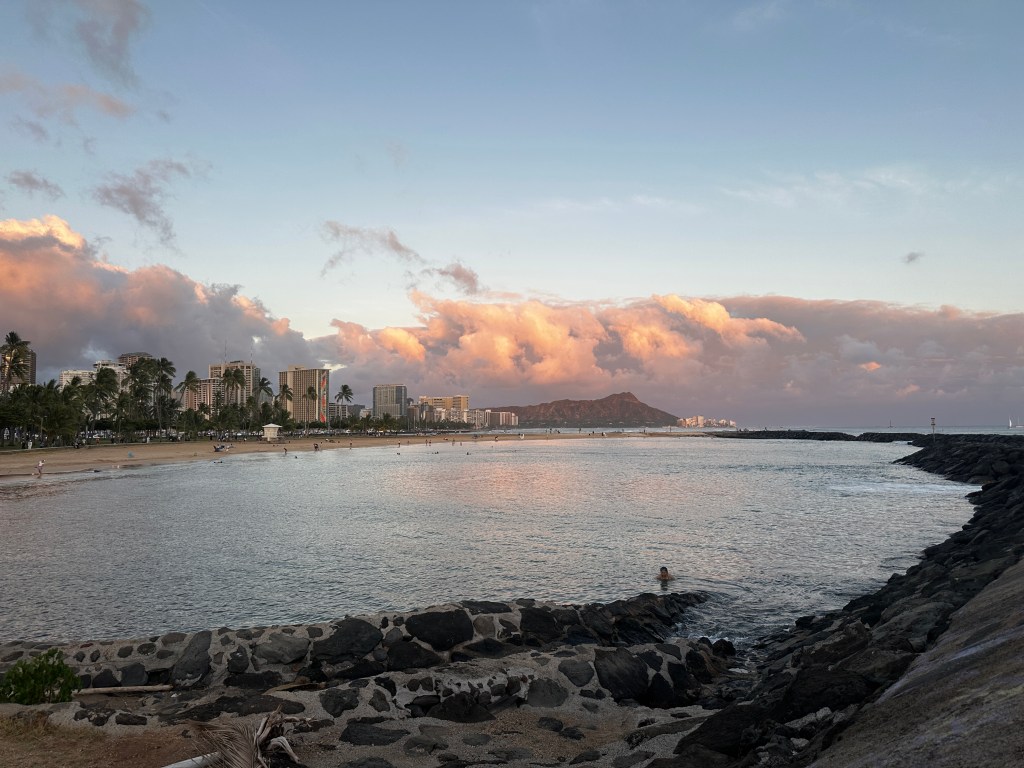
August 1, 2026 – 9:41 a.m., Magic Island, Honolulu
I usually come to Magic Island between six and eight in the morning.
That’s my favorite time of day.
The beach is quiet. The trade winds are cool. The sound of the waves is louder than the traffic. A few runners pass by. Someone paddles quietly toward the horizon. An elderly couple walks hand in hand without saying much.
This morning felt even quieter than usual.
It was Saturday.
Oddly, I saw fewer people than I normally do on weekend mornings.
My first instinct was to explain it.
Maybe people were traveling.
Maybe there was another event happening somewhere else on Oʻahu.
Maybe the weather forecast discouraged people from coming.
Then I stopped.
The truth was…
I had no idea.
I had an observation.
Not an explanation.
That small realization stayed with me for the rest of the morning.
And it made me wonder.
How often do we mistake our observations for explanations?
The Most Dangerous Sentence Is “I Already Know Why.”
Human beings are remarkably good at recognizing patterns.
Sometimes, we recognize them too quickly.
We see a crowded restaurant and assume the food must be excellent.
We see an expensive product and assume it must be higher quality.
We hear one piece of news and immediately begin searching for someone to blame.
Our minds dislike uncertainty.
When we don’t know, we naturally want an explanation.
The problem is that reality doesn’t owe us immediate answers.
Sometimes the first explanation we think of is correct.
Sometimes it isn’t.
The difficult part is that, at the beginning, they often feel exactly the same.
Observation Is Not Evidence
This morning at Magic Island reminded me of one of the most important lessons economics has taught me.
Observation is where research begins.
It is not where research ends.
One quiet Saturday morning does not tell me whether beach attendance is changing.
One expensive tomato does not prove inflation is accelerating.
One successful business does not prove a policy works.
One personal experience does not automatically become evidence about society.
An observation gives us something incredibly valuable.
A question.
Nothing more.
Nothing less.
Before studying economics, I imagined economists as people who had answers.
The more economics I study, the more I realize their greatest strength is often the opposite.
Good economists become comfortable saying,
“I don’t know yet.”
Not because they lack knowledge.
But because they respect evidence.
Instead of asking,
“How can I prove that I’m right?”
they ask,
“What evidence would convince me that I’m wrong?”
That is a completely different way of thinking.
And perhaps one of the hardest habits to develop.
The Question Behind Every Statistic
People often think economics is about numbers.
GDP.
Inflation.
Unemployment.
Interest rates.
Those numbers matter.
But statistics never arrive with meaning attached to them.
They only answer the questions we ask.
If we ask poor questions, even perfect data can produce misleading conclusions.
If we ask thoughtful questions, imperfect data can still help us understand the world a little better.
Perhaps the quality of our research depends less on the sophistication of our statistical methods than on the quality of the questions that came before them.
Why Curiosity Matters More Than Certainty
This morning, I didn’t discover why Magic Island was quieter than usual.
I still don’t know.
Maybe tomorrow I’ll notice the opposite.
Maybe today’s observation was nothing more than chance.
And that’s perfectly acceptable.
Science doesn’t begin when we find answers.
It begins when we become curious enough to admit that we don’t yet have them.
Perhaps that’s why I no longer think economics begins with equations.
Equations are tools.
Statistics are tools.
Models are tools.
Curiosity comes first.
When I first started studying economics, I thought I was learning how to analyze markets.
Now I think I was learning something much more fundamental.
I was learning how to live with uncertainty.
How to slow down before reaching conclusions.
How to separate what I observed from what I merely assumed.
In a world overflowing with opinions, that may be one of the most valuable lessons economics has ever given me.
So the next time you catch yourself saying,
“I know exactly why that happened,”
pause for a moment.
Ask yourself one more question.
Do I have an explanation…
or do I simply have an observation waiting to be tested?
—
Heidi Ahihi
“Discovering economics through everyday life in Hawaiʻi.”




Leave a comment