August 1, 2026 – 2:30 p.m., Honolulu
I had just woken up from an afternoon nap.
The morning had been full.
I started the day at Magic Island, spent time enjoying the peaceful beach, worked out at the gym, came home to cook lunch, and finally gave myself permission to rest.
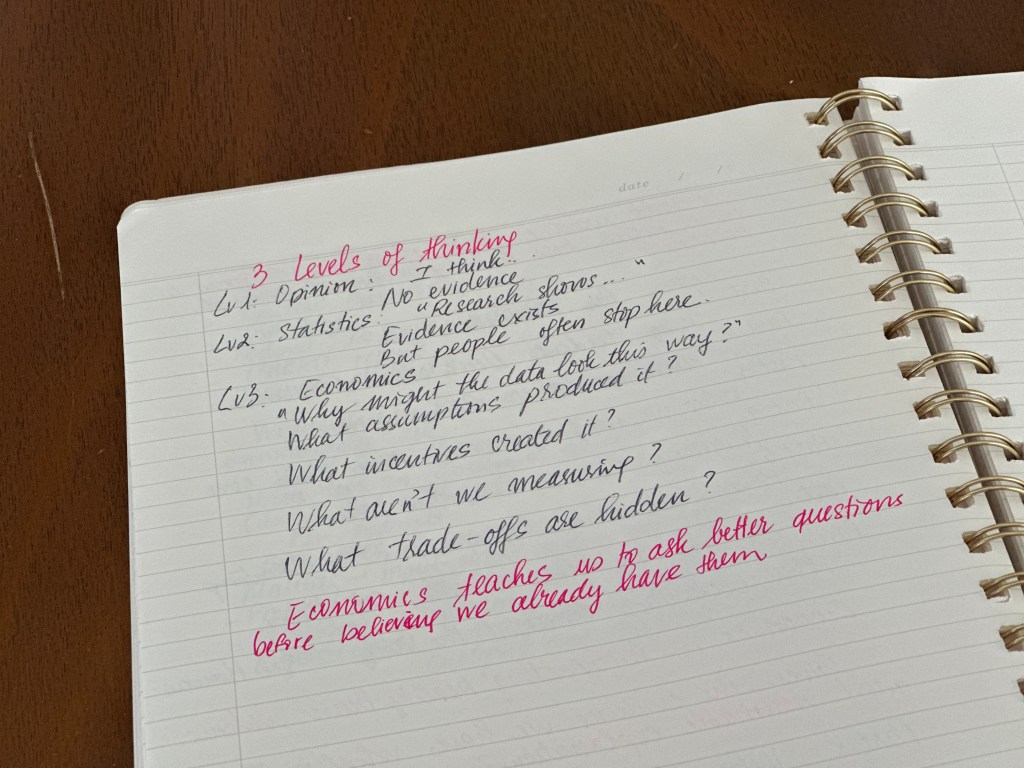
When I woke up, I opened my notebook to plan the first series of articles for Heidiahihi.
One question kept coming back to me.
Why don’t more students choose economics?
At first, it sounds like a simple question.
But the more I thought about it, the more I realized I had been asking the wrong one.
Perhaps the better question is:
Why do so many people misunderstand what economics actually is?
“Economics Is About Money.”
Whenever I tell people that I study economics, I usually hear one of these responses.
“Oh, so you’re learning about money.”
“You must be really good at math.”
“That’s for people who want to work on Wall Street.”
“Accounting is more practical.”
None of those answers are completely wrong.
But none of them describe what made me fall in love with economics.
Before I studied economics, I believed those things too.
I thought economics was mostly about inflation, interest rates, stock markets, and complicated graphs that only professors could understand.
Then I stepped into my first economics classroom.
Everything changed.
Economics Didn’t Teach Me About Money.
It Taught Me How to Think.
The biggest surprise wasn’t learning new theories.
It was discovering a completely different way of looking at the world.
Instead of asking,
“Is this good or bad?”
Economics encouraged me to ask,
“Compared to what?”
Instead of saying,
“This policy failed.”
Economics asks,
“Failed for whom? Under what conditions? Compared with which alternative?”
Instead of jumping to conclusions,
economics teaches us to pause.
Observe.
Question.
Collect evidence.
Only then do we begin to form conclusions.
That way of thinking extends far beyond economics.
It changes how we read the news.
How we understand politics.
How we evaluate public policies.
Even how we make decisions in our own lives.
The Problem Isn’t Economics.
The problem is how economics is introduced.
Many students meet economics through graphs before curiosity.
Through formulas before questions.
Through memorization before observation.
Imagine learning to appreciate music by memorizing sound waves before hearing a beautiful song.
Or learning photography by studying camera specifications before looking at a breathtaking sunset.
Sometimes we introduce the tools before we explain why they matter.
Economics deserves a better introduction.
It begins with people.
With everyday choices.
With wondering why the world works the way it does.
The equations come later.
Hawaii Changed My Perspective
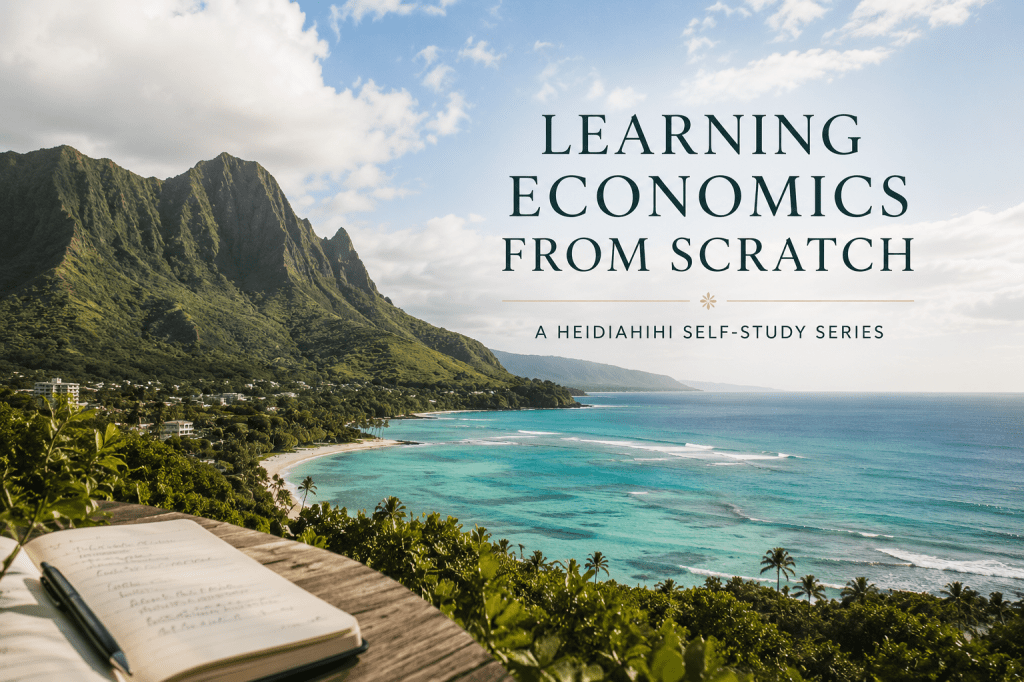
Living in Hawaiʻi has made this even clearer to me.
A morning at Magic Island isn’t just a beautiful experience.
It raises economic questions.
Why do public beaches matter?
Why do people value places that have no admission fee?
How do we measure the benefits of clean air, open spaces, or community?
Walking through Chinatown makes me wonder why some vegetables are imported while others are grown locally.
Riding TheBus makes me think about public transportation, accessibility, and opportunity cost.
Economics isn’t hidden inside a textbook.
It’s happening all around us.
We just need to learn how to notice it.
Curiosity Before Certainty
One sentence has stayed with me throughout my economics journey.
Economics is interpreting reality through evidence.
Notice what that doesn’t say.
It doesn’t say economics always has the correct answer.
Because the world is complicated.
Evidence is often incomplete.
New research can change what we think we know.
That’s why I believe one of the most important lessons economics can teach is intellectual humility.
The goal is not to prove ourselves right.
The goal is to understand reality a little better than we did yesterday.
Sometimes that means changing our minds.
Sometimes it means admitting,
“We don’t know yet.”
And that’s not a weakness.
That’s how science moves forward.
If you had asked me a few years ago what economics was, I probably would have answered,
“Money.”
Today, my answer is different.
Economics taught me to slow down.
To observe before judging.
To ask better questions before searching for answers.
To let evidence challenge my assumptions instead of protecting them.
Maybe that’s why I don’t want to teach economics.
I want to teach people how to see the world through economics.
Because once you learn to ask better questions, you never look at the world in quite the same way again.
—
Heidi Ahihi
“Discovering economics through everyday life in Hawaiʻi.”




Leave a comment